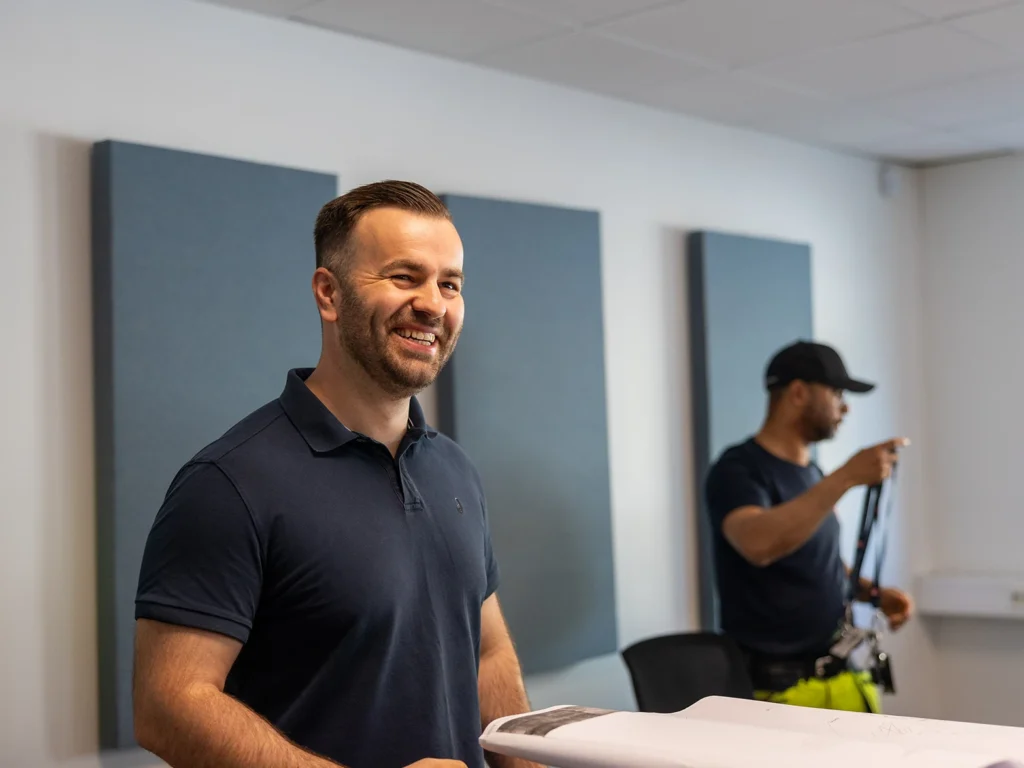
Kurt works as an operational project manager focusing on FTTH (Fiber to the Home) development at Transtema in Norway. He is primarily responsible for FTTH deployment projects for our largest customer in Norway and manages a team of nine technicians. Kurt himself has a background as a technician. He started as an apprentice, quickly learned the job, and realized it was something he enjoyed. Except for a few years in the Norwegian defense sector, he has worked in the telecom industry his entire career. For ten years, Kurt worked as a subcontractor for what is now Transtema in Norway.
I already had a very good impression of the company before I joined because we had worked closely together during my years as a subcontractor. In 2019, I contacted someone in the company to discuss the possibility of becoming an employee, which I eventually did. I had requirements upon hiring to be able to grow with the company, which I have been given the opportunity to do. At the end of 2020, I transitioned to the role of operational project manager, and at the beginning of 2022, we became part of the Transtema Group. A lot has happened during my years with the company, both in terms of my job role and the company itself.
Tell us about your job as an operational project manager
In my role as an operational project manager, I am responsible for many of our FTTH deployment projects. The technicians in my team work on building fiber from the central hub to the project site, completing the entire project, laying fiber to each property, performing installations, and ensuring that all customers are connected. We work on projects that often last several months up to a year, with hundreds of customers to connect in each project.
As an operational project manager, I am responsible for the project from the planning stage until the entire project is built out. The project isn’t complete until all work is finished and delivered with complete documentation. I have to ensure we meet schedules, monitor costs and changes, and handle much of the administrative and operational tasks, such as agreements, contacting property owners, meetings with counties and municipalities, site inspections, and more. I also follow up and report on our projects to other functions in the company and have weekly contact with the client.
As a personnel manager, I lead the technicians in my group in their daily work. I emphasize having close communication with my team and do everything I can to keep them motivated and satisfied. I also handle all aspects of being a personnel manager, such as booking travel for staff, ordering work clothes, tools and equipment, managing sick leave, payroll, job positions, and more.
The change in the group’s working method has led to positive development.
When I started as a project manager, all the technicians in my team did a bit of everything, and no one had a specific focus. This was something I identified as an area for improvement and changed quite early on. Today, we are divided into three groups, each with its specific focus area: building aerial networks, blowing fiber, and splicing fiber. Everyone can still work in all areas, and we work based on the area with the greatest need. But the difference is that the various groups have primary responsibility for their area and get the opportunity to specialize and develop their skills. The change has been very well received, and the team members enjoy becoming particularly skilled in a specific area. We have a good atmosphere throughout the group, and everyone helps each other when needed.
What’s the best part of your job as an operational project manager?
The best part of my job as an operational project manager is that no two days are the same. Some days I am in the office handling administrative tasks, meetings, and more. Other days, I am out in the field visiting our projects around Norway, sometimes in the local Oslo area and other times in completely different parts of the country. As an operational project manager, I get the opportunity to try new things and continuously develop.